
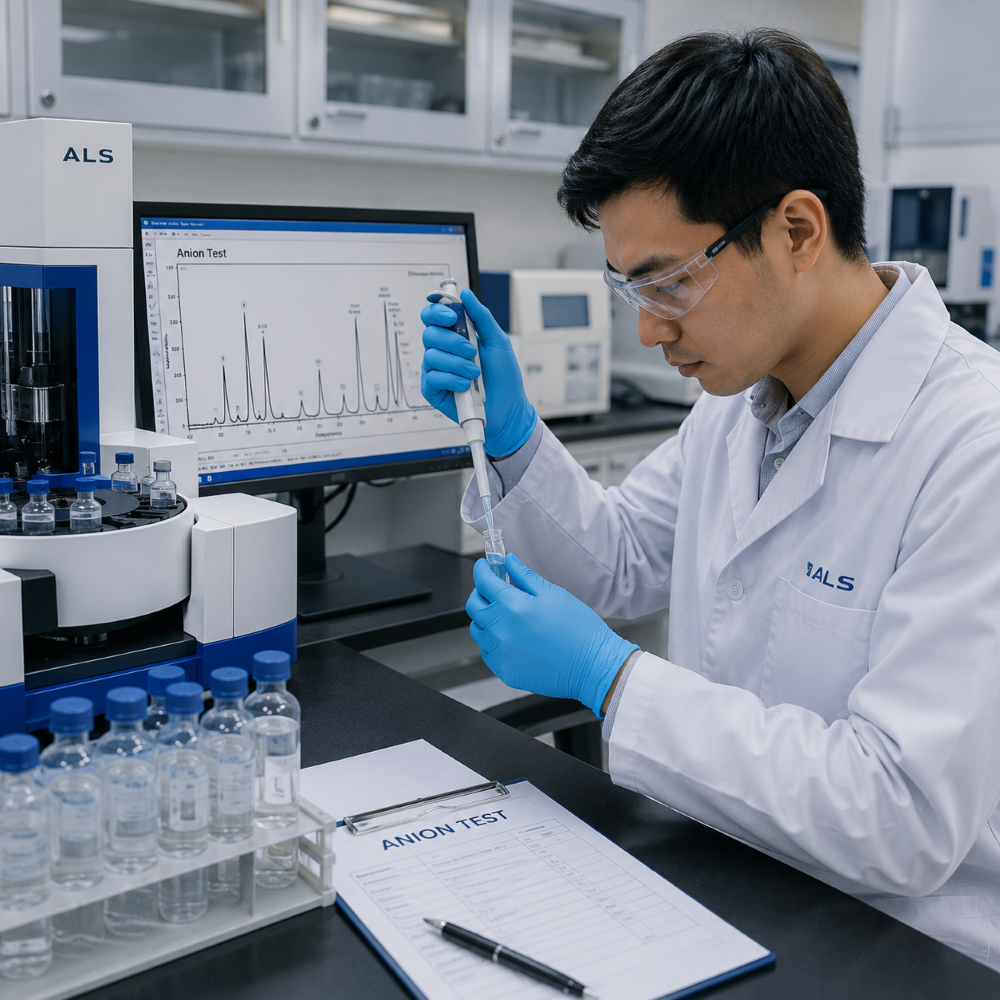
Anion Test for Electronics: Finding Hidden PCB Contamination
A PCB can pass visual inspection and work fine during production testing, then still fail months later out in the field. One common cause is ionic contamination left behind from soldering, cleaning, handling, or storage, residue that’s invisible under normal inspection but can turn conductive once moisture gets involved. An anion test uses ion chromatography to separate and measure the negatively charged ions pulled from a PCB, identifying individual ions like chloride, fluoride, bromide, nitrate, sulfate, acetate, and formate instead of just giving one lump contamination number.
Why Anionic Contamination Matters
Under dry conditions, ionic residue usually just sits there without causing an immediate problem. Things get risky once humidity rises, since the residue can dissolve into a thin moisture layer and create a conductive path between circuits that shouldn’t be connected. Add voltage into the mix and those ions can migrate, contributing to corrosion, leakage current, or dendrite growth, often showing up as an intermittent short that’s hard to reproduce on a normal room-temperature test bench. Automotive electronics carry extra risk here because they go through temperature cycling, vibration, and condensation over long service lives.
Chloride gets the most attention since it’s highly mobile and speeds up corrosion. Acetate and formate usually point to organic-acid or no-clean flux residue, while sulfate and nitrate tend to trace back to processing chemicals or general handling and environmental exposure.
What an Anion Test Can Detect
Results are reported as the concentration of each ion in the extract, which can be converted into surface contamination per unit area. Acceptance limits should come from the customer’s spec or the relevant electronics standard rather than one blanket number applied to every product.
| Anion | Possible source | Why it matters |
| Chloride | Flux residue, handling, environmental exposure | Highly mobile, linked to corrosion risk |
| Fluoride | Flux chemistry or etching residue | Can corrode certain metals |
| Bromide | Flux systems or flame-retardant materials | May add to corrosion at higher levels |
| Sulfate | Process chemicals or environmental contamination | Can signal insufficient cleaning |
| Acetate | Organic-acid or no-clean flux residue | Hygroscopic, can promote leakage current |
| Formate | Flux activator decomposition products | Can indicate active residue after soldering |
Finding a specific ion doesn’t automatically prove where it came from. Results should be compared against flux chemistry, process water, cleaning agents, and contamination patterns across the whole assembly.
How Ion Chromatography Works
The sample gets extracted first, so soluble ionic residue moves off the component surface into a liquid solution. Under IPC-TM-650 Method 2.3.28, PCB assemblies are typically extracted using a set mix of isopropyl alcohol and deionized water, under controlled temperature, time, and agitation.
That extract goes into the ion chromatography system, where each anion interacts differently with the column and comes out at its own retention time, creating a separate peak per ion. Calibration standards with known concentrations are used to work out how much of each ion is present. Anion and cation testing need different column and mobile-phase setups since the ions carry opposite charges, so a full check usually runs both from the same extraction solution.
Anion Testing vs ROSE Testing
ROSE testing measures the overall conductivity of a solvent extract and gives one combined contamination number, often expressed as sodium chloride equivalent. It’s fine for quick production screening, but it can’t tell you which ions are actually present.
| Comparison | ROSE testing | Ion chromatography |
| Result | One total conductivity value | Individual ion concentrations |
| Identifies specific ions | No | Yes |
| Diagnostic value | Limited | Supports source investigation |
| Typical use | Routine process screening | Qualification and failure analysis |
Ion chromatography gives a separate concentration for each anion and cation, which matters more when tracing a contamination source or meeting an OEM spec that requires individual species data. Neither method always replaces the other. The right choice depends on the customer spec and what the investigation needs to answer.
When to Request Testing
Anion testing tends to come up during new-process qualification, supplier approval, flux changes, cleaning validation, and failure investigations, or as routine monitoring for safety-critical assemblies. It’s especially useful when boards show intermittent faults after humidity exposure, corrosion near conductors, or failures that only appear once the board has been in service a while.
Manufacturers arranging an anion test can give ALS Testing the PCB dimensions, cleanliness specification, flux type, soldering process, cleaning method, and suspected failure area. ALS Testing runs anion and cation analysis using ion chromatography, with individual species reporting and chromatogram data to support engineering review.
Turning Results Into Process Improvement
High chloride concentrated around one production area usually points to a local flux, handling, or cleaning issue, while elevated acetate or formate often leads engineers to review the soldering profile or flux compatibility. Corrective steps might include adjusting the soldering profile, changing flux application rate, or improving process-water control, and follow-up samples should be tested under the same extraction and reporting conditions so results stay comparable.
Manufacturers arranging an anion test can give ALS Testing the PCB dimensions, cleanliness specification, flux type, soldering process, cleaning method, and suspected failure area. ALS Testing runs anion and cation analysis using ion chromatography, with individual species reporting and chromatogram data to support engineering review.
The laboratory also supports electronics manufacturers and EMS providers with ion chromatography testing for projects in Malaysia, helping verify PCB cleanliness during process validation, quality investigations, and reliability improvement programmes. Used this way, an anion test becomes more than a pass-or-fail check. Connected to the actual manufacturing process, it can help catch latent electrical failures before affected assemblies ever reach the field.